


 AUS
AUS
 IND
IND
Bookkeeping vs Accounting: Roles and Key Differences Explained for Business Owners
If you’ve ever found yourself using bookkeeping and accounting interchangeably, you’re not alone. Many business owners assume they’re the same thing, until a missed compliance deadline, unclear financial reports, or cash flow surprises highlight otherwise.
Understanding bookkeeping vs accounting isn’t just about knowing definitions. It’s about knowing who does what, why it matters, and when your business needs each function. Whether you’re a startup founder, a small business owner, or running a growing company, clarity here can directly impact your decisions, compliance, and long-term growth.
This guide breaks down the roles, responsibilities, and differences between bookkeeping and accounting in a way that’s practical, relatable, and easy to apply.
What Is Bookkeeping?
Bookkeeping is the process of systematically recording financial transactions of a business. It forms the backbone of your financial system and ensures that every dollar coming in and going out is properly documented.
Think of bookkeeping as the financial diary of your business. It captures what happened, when it happened, and how much was involved, without interpreting or analyzing the data.
Bookkeeping is ongoing and detail-oriented. It focuses on accuracy, consistency, and completeness. According to the Gitnux Bookkeeping Statistics Report 2025, manual bookkeeping errors occur in approximately 1% of all keystrokes, and over 40% of small businesses incur IRS penalties because of payroll errors, highlighting how even small mistakes can have serious consequences for business finances.
Key Responsibilities of a Bookkeeper
The day-to-day bookkeeping vs accounting tasks differ significantly, and bookkeeping responsibilities typically include:
- Recording daily financial transactions
- Managing sales invoices, purchase bills, and receipts
- Reconciling bank and credit card statements
- Tracking expenses and categorising them correctly
- Managing payroll processing and employee payments
- Maintaining general ledgers and journals
- Ensuring financial data is organised and up to date
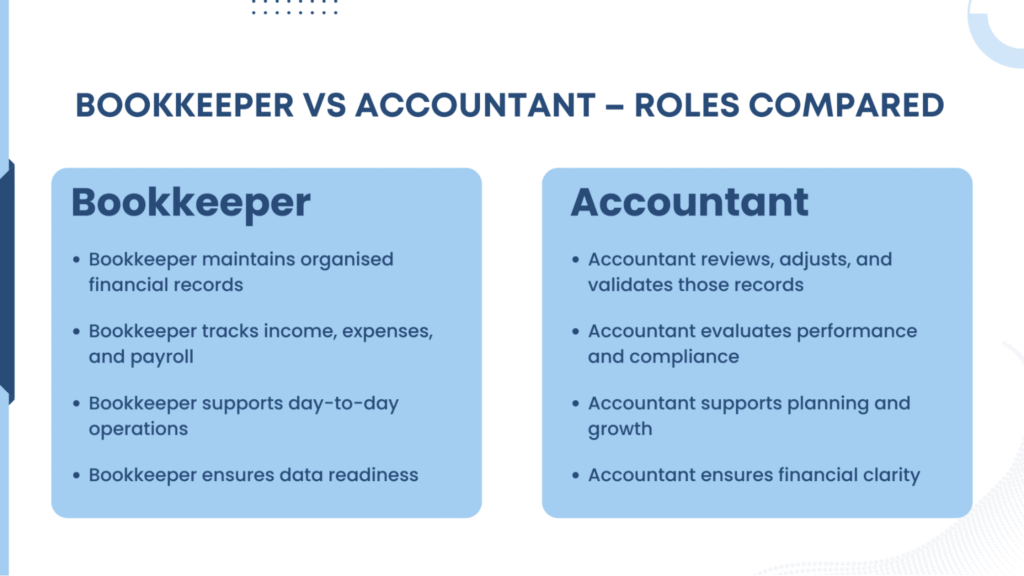
A bookkeeper ensures your records are clean, current, and reliable, so that accountants can later work with accurate information.
What Is Accounting?
Accounting takes the data recorded through bookkeeping and turns it into meaningful insights. While bookkeeping answers “What happened?”, accounting answers “What does it mean?” and “What should we do next?”
Accounting involves interpreting financial data, preparing reports, ensuring compliance, and advising on business performance and strategy. It is broader in scope and more analytical in nature.
Key Responsibilities of an Accountant
The accounting and bookkeeping roles overlap in data dependency, but accounting responsibilities typically include:
- Preparing financial statements (Profit & Loss, Balance Sheet, Cash Flow)
- Reviewing and interpreting financial performance
- Tax planning and tax return preparation
- Budgeting and financial forecasting
- Identifying risks, inefficiencies, and opportunities
- Ensuring statutory and regulatory compliance
- Supporting strategic business decisions
Accountants don’t just report numbers, they use them to guide decisions
Bookkeeping vs Accounting: Key Differences Explained
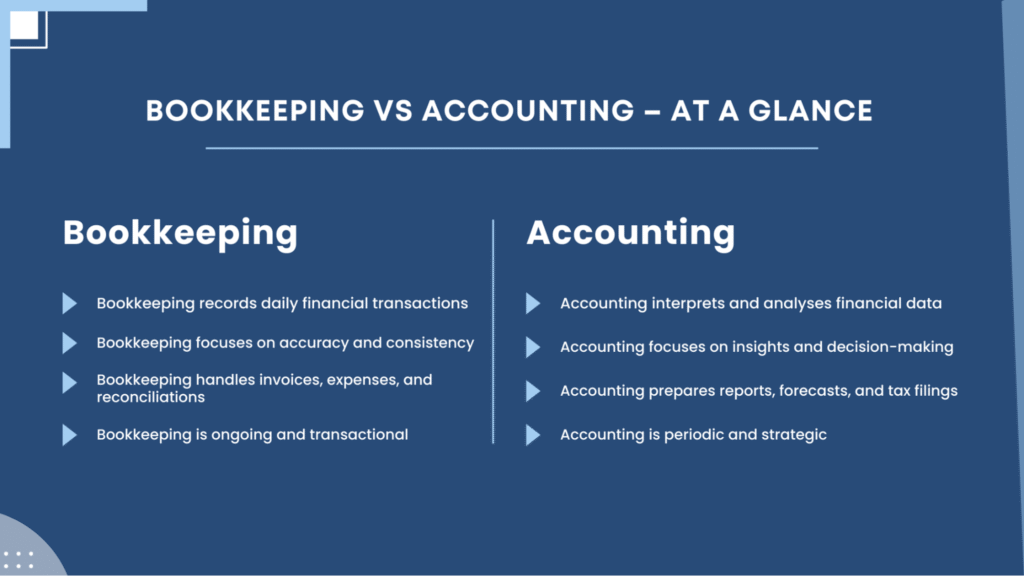
To clearly understand the difference between bookkeeping and accounting, it helps to compare them across several dimensions.
1. Scope of Work
Bookkeeping focuses on recording transactions accurately. Accounting focuses on analysing, summarising, and interpreting those records.
2. Timing
Bookkeeping is performed daily or weekly. Accounting is usually performed monthly, quarterly, or annually.
3. Nature of Work
Bookkeeping is transactional and process-driven. Accounting is analytical, advisory, and compliance-focused.
4. Skill Sets
Bookkeepers need attention to detail and system accuracy. Accountants require technical knowledge, regulatory understanding, and analytical skills.
5. Output
Bookkeeping produces organised financial records. Accounting produces reports, insights, and financial guidance.This distinction is often summarised as bookkeeper vs accountant, one ensures accuracy at the ground level, the other ensures clarity at the decision-making level.
How Bookkeeping and Accounting Work Together
Despite their differences, bookkeeping and accounting are interdependent, not competing functions.
Without proper bookkeeping:
- Accounting reports become unreliable
- Tax filings risk errors
- Business decisions are made on incomplete data
Without accounting:
- Bookkeeping data remains unused
- Compliance risks increase
- Strategic opportunities are missed
In practice, bookkeeping feeds data into accounting. Accounting then reviews, adjusts, and interprets that data to support business health and direction. A well-functioning financial system requires both roles working in sync.
Which Does Your Business Need?
The answer isn’t always either/or, it depends on your stage and complexity.
Early-Stage or Small Businesses
- Basic bookkeeping to track income and expenses
- Periodic accounting for tax filing and compliance
Growing Businesses
- Ongoing bookkeeping to manage higher transaction volumes
- Regular accounting reviews for cash flow, margins, and planning
Established or Scaling Businesses
- Full bookkeeping support
- Strategic accounting for forecasting, performance analysis, and risk management
Understanding bookkeeping vs accounting helps businesses invest in the right level of financial support without overpaying or under-resourcing.
In-House vs Outsourced: A Practical Perspective
Many businesses struggle with whether to hire internally or outsource.
In-House Teams
- Higher fixed costs (salaries, systems, training)
- Dependence on individual availability
- May lack depth across multiple compliance areas
Outsourced Support
- Access to specialised expertise
- Cost-effective scaling as business grows
- Consistency and process-driven delivery
- Reduced compliance and reporting risk
For many businesses, outsourcing bookkeeping and accounting allows access to both skill sets without building a large internal team, especially as regulations and reporting requirements become more complex.
Common Misconceptions About Bookkeeping and Accounting
“Bookkeeping is just data entry”
In reality, accurate bookkeeping requires understanding categorisation, reconciliations, and financial systems.
“Accounting replaces bookkeeping”
Accounting relies entirely on bookkeeping data. One cannot function without the other.
“Small businesses don’t need accountants”
Even small businesses face tax, compliance, and reporting obligations that benefit from accounting oversight. Clarifying these misconceptions helps businesses appreciate the true value of both roles.
How Technology Has Changed Both Roles
Modern accounting software has transformed both bookkeeping and accounting.
- Automated transaction feeds reduce manual entry
- Cloud platforms enable real-time reporting
- Integrated payroll and tax systems improve accuracy
- Dashboards provide instant financial visibility
However, technology hasn’t eliminated the need for professionals. Instead, it has shifted focus, from manual work to review, judgement, and decision support.
Understanding bookkeeping vs accounting tasks in a tech-enabled environment is more important than ever.
Final Thoughts: Bookkeeping vs Accounting Is Not a Choice, It’s a System
The conversation around bookkeeping versus accounting often misses the real issue. One is not superior to the other. They serve distinct but complementary roles within the same financial ecosystem.
Bookkeeping creates the foundation.
Accounting turns that foundation into insight.
When aligned properly, they enable businesses to:
- Remain compliant
- Clearly understand financial performance
- Plan with confidence
- Make informed, strategic decisions
When financial data feels unclear or disconnected, the problem is rarely the numbers themselves. More often, it stems from how bookkeeping and accounting are structured, integrated, and supported.
Clarity begins with understanding each role. Control comes from ensuring both work together effectively.If you are looking for smarter, more reliable bookkeeping solutions that support better decision-making, contact our team today.